


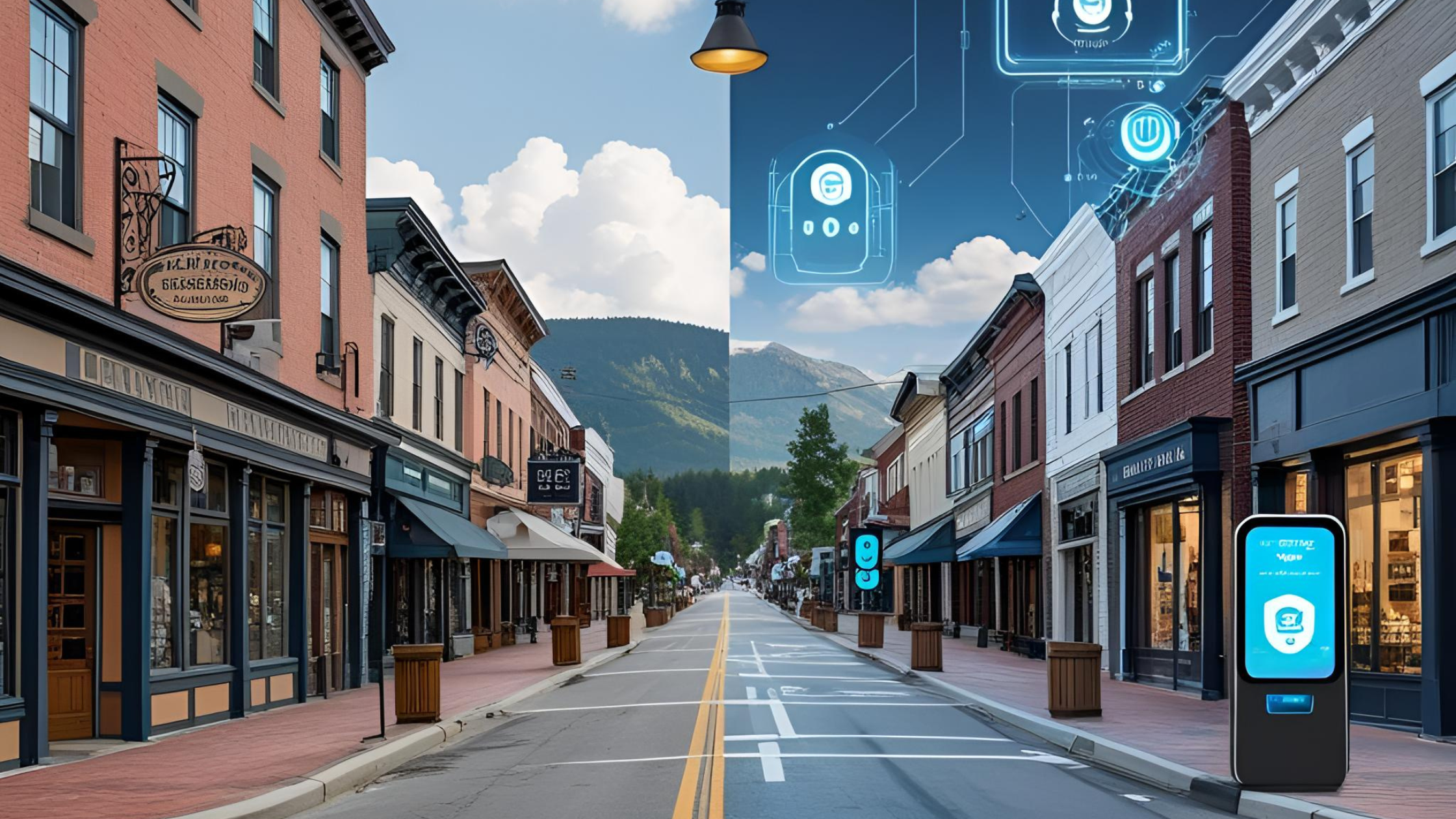
Small Towns Are Using AI to Transform Public Services
Here is a number worth sitting with: according to a 2025 National League of Cities report, a global study of 250 cities found that 56% were actively piloting or deploying AI to upgrade operations and services, with 83% planning to do so within three years. That is not a "big city" story. The NLC report explicitly names "cities, towns and villages" across the U.S. as part of this shift, including communities that most people would not associate with frontier technology adoption.
Small towns have spent years being told they lack the budget and technical capacity to modernize. Some of that was true. But AI tools have gotten cheap and accessible enough that a municipality with a lean team and a tight budget can now automate the work that used to require three full-time employees, answer citizen questions at 2 a.m. without anyone on the clock, and catch a failing water main before it turns into a six-figure emergency repair. The gap between what a town of 8,000 can offer and what a city of 800,000 can offer is narrowing in ways that would have seemed implausible five years ago.
This post covers where that is actually happening, which technologies are doing the work, what the real constraints look like, and how small towns can start without betting the entire municipal budget on a single vendor's demo.
Why Small Towns Have More to Gain Than Anyone
Large cities have IT departments with data scientists, procurement officers, and a dedicated innovation team or two. A small town often has one person who covers IT, handles the website, and fixes the printer — and that same person occasionally helps the parks department figure out why the irrigation system stopped working. That is not an exaggeration; it is a structural reality for hundreds of municipalities across the country.
This is exactly why AI is disproportionately useful at the small-town scale. RTInsights notes that AI-powered tools can handle routine, repetitive tasks, including answering common citizen inquiries, processing standard permit applications, and flagging infrastructure anomalies, without requiring dedicated staff to monitor them around the clock. For a large city, automating those tasks is a nice efficiency gain. For a small town, it can be the difference between keeping a service running and eliminating it entirely.
Recruiting is the other side of this. Small towns cannot compete with private-sector salaries for software engineers or data analysts, and they never will. But they do not need to hire those people if the tools they are deploying are designed to be operated by generalists. Cloud-based AI platforms have dropped in cost significantly over the past several years, and the interfaces have become genuinely usable by non-specialists. A town administrator who can navigate a spreadsheet and a browser can now run a chatbot that handles several hundred citizen inquiries a month, no coding required.
Budgets are tight and infrastructure is aging, while citizens increasingly expect digital access to services. The towns that are figuring this out are not doing it because they love technology; they are doing it because the alternative is cutting services they cannot afford to cut.
The Four Technologies Actually Doing the Work
Strip away the hype and there are four core AI capabilities showing up repeatedly in local government deployments. Understanding what each one does makes it easier to match the tool to the actual problem.
Natural Language Processing and Chatbots
Natural language processing is what allows a chatbot to understand a question written in plain English and return a useful answer, rather than forcing citizens to navigate a phone tree or wait for a staff member to respond to an email. In local government, this typically means a virtual assistant on the town website that can answer questions about utility billing, park hours, and permit requirements at any hour of the day.
The 24/7 availability is not a trivial benefit. Most small-town offices are open roughly 40 hours a week. A chatbot covers the other 128. The NLC report highlights citizen engagement as one of the primary areas where AI is already delivering value in towns and cities of all sizes, specifically because it extends access without extending payroll.
Machine Learning for Predictive Maintenance
This is where the financial case for AI gets most concrete. Machine learning models trained on historical maintenance records and live sensor readings can identify patterns that precede infrastructure failures, whether that is a water main showing stress indicators, a road segment approaching the point where a crack becomes a pothole, or HVAC equipment in a municipal building trending toward failure.
Harvard's Data-Smart City Solutions documents how this shift from reactive to preventive public works management changes the cost equation significantly. Emergency repairs are almost always more expensive than scheduled maintenance, and they tend to happen at the worst possible time. A small town that can predict where its infrastructure is most likely to fail in the next six months and schedule work accordingly is spending its limited maintenance budget far more efficiently than one that waits for the phone calls to start.
Computer Vision for Inspection and Monitoring
Computer vision, meaning AI that interprets images and video, lets local governments detect road damage from street-level imagery and monitor traffic flow without manual inspection of every block in a jurisdiction. UrbanSDK's overview of AI in local government describes how visual inspection tools can process footage from cameras or mobile surveys, identify problems, and produce a ranked list of locations that need attention.
For a small town with limited public works staff, this matters a lot. Running a visual survey of every road in a 30-square-mile municipality manually takes weeks. Running the same imagery through a computer vision system takes hours. Staff can then focus their time on the actual repair work rather than the detection work, which is a better use of anyone's Tuesday.
Generative AI for Internal Productivity
Large language models are showing up in local government in a less flashy but genuinely useful way: drafting routine correspondence, summarizing public meeting transcripts, and generating first drafts of reports that previously required hours of manual writing. CAI's analysis of generative AI in local government points to document summarization and internal knowledge management as two of the highest-value early applications, particularly for small teams where every hour of administrative work is an hour not spent on higher-priority tasks.
RSM's 2024 survey of state and local government AI trends found that governments are moving from experimentation to broader piloting, with internal productivity tools among the most commonly adopted applications. That makes sense: the risk is lower than deploying a citizen-facing system, the benefits are immediate, and it does not require any changes to public-facing processes.
Where Real Deployments Are Happening
The headline of this post promises concrete examples, so let's be honest about what the evidence actually shows. Hard, independently verified data on small-town AI deployments is still sparse. Most documented case studies come from mid-size cities or from vendor-published success stories that deserve healthy skepticism. That said, there are real, documented examples worth examining.
Chattanooga, Tennessee: Predictive Infrastructure at Scale
Chattanooga (population roughly 180,000, so not a small town, but instructive for smaller municipalities) has used sensor data and predictive analytics to manage its electric grid and reduce outage response times. Harvard's Data-Smart City Solutions cites Chattanooga's approach as a model for how predictive maintenance can shift public works from emergency response to planned intervention, with measurable reductions in reactive repair costs. The infrastructure and data principles scale down; the specific dollar figures do not transfer directly to a town of 10,000, but the operational logic does.
Kansas City, Missouri: Chatbots Handling Citizen Services
Kansas City deployed an AI-powered virtual assistant to handle resident inquiries about city services, reducing call volume to human staff and extending service availability. RTInsights documents how cities using AI for citizen-facing services have reduced the volume of calls requiring live staff intervention, freeing those staff members for more complex issues. The deployment model, a chatbot handling tier-one inquiries while routing complex cases to humans, is directly replicable at smaller scale.
Smaller Communities Following the Pattern
The NLC report notes that AI adoption is not limited to large urban centers, with smaller cities and towns piloting tools across permitting and infrastructure monitoring. The honest caveat is that independently verified, named case studies from towns under 50,000 population are still limited in the public record. Many small-town deployments are too recent or too underdocumented to cite with confidence. What is documented is the pattern: the tools work at small scale, the costs have come down enough to be accessible, and the operational logic is sound.
Any vendor promising a specific percentage cost reduction without showing you the underlying methodology and an independent audit deserves a raised eyebrow. The 30-50% cost savings figures that circulate in this space typically come from vendor case studies or pilot programs in specific service areas, not from comprehensive independent analysis across municipalities. Early evidence, documented by sources like Harvard's Data-Smart City Solutions, points to real cost avoidance in predictive maintenance and real efficiency gains in digital self-service. "Real" and "transformative" are not the same thing as "guaranteed."
The Actual Challenges (Not the Sanitized Version)
Every article about AI in government eventually gets to a section called "challenges," which usually lists things like "change management" and "data quality" in a way that makes them sound like minor inconveniences. They are not minor. Here is what actually gets in the way.
Legacy Systems That Will Not Talk to Each Other
Many small towns are running critical municipal functions on software that predates the current decade by a significant margin. Tax collection, utility billing, property records: these systems were not designed to share data with anything, let alone a machine learning model. Deploying AI on top of fragmented, siloed data infrastructure is like trying to train a navigation system using maps from different decades that do not agree on where the roads are.
RSM's analysis identifies data infrastructure and integration as one of the primary barriers to AI adoption in state and local government. This is not a problem that a chatbot deployment solves; it is a prerequisite problem that has to be addressed before many AI applications can function reliably.
The Skills Gap Is Real, Even With Better Tools
Cloud-based AI tools are more accessible than they were five years ago, but "more accessible" still requires someone who can configure them and keep them running over time. CAI's assessment notes that local governments frequently lack the internal technical capacity to evaluate AI vendors or troubleshoot problems when they arise. That creates dependence on vendors, which is fine until the vendor changes its pricing or simply stops responding quickly to a problem.
The solution is not necessarily hiring a data scientist. It is building enough internal literacy that someone on staff can ask the right questions, spot when outputs look wrong, and know when to escalate. That is a training and organizational investment, not just a technology purchase.
Cybersecurity Is Not Optional
Small municipalities are increasingly targeted by ransomware and phishing attacks, partly because their security infrastructure is often minimal. Deploying AI tools that handle citizen data or utility information without a corresponding investment in security is genuinely risky. RTInsights flags cybersecurity as a critical consideration for any government AI deployment, and it deserves more than a checkbox in the procurement process.
Equity and Access
A 24/7 AI chatbot is only useful to residents who have reliable internet access and are comfortable using digital tools. In many small towns and rural communities, a meaningful portion of the population does not meet both criteria. The NLC report emphasizes that AI deployments in local government need to account for digital equity, ensuring that efficiency gains for one segment of the population do not come at the cost of reduced access for another. Deploying a chatbot and eliminating the phone line is not a modernization success story if it cuts off residents who cannot use the chatbot.
How to Actually Start: A Practical Framework
The following is not a vendor pitch. It is a sequence that reflects how successful small-town deployments tend to unfold, based on the patterns documented in independent sources.
Start With the Pain, Not the Technology
The most common mistake in government technology adoption is leading with the tool rather than the problem. Before evaluating any AI platform, document your highest-volume, most repetitive service interactions. Count the phone calls about trash pickup schedules. Measure how long permit applications sit in a queue. Identify which infrastructure complaints come in repeatedly before anything gets fixed.
Those are your pilot candidates. A chatbot that handles your top ten most common citizen inquiries is a tractable, measurable project. "Implementing AI" is not a project; it is a category.
Assess Your Data Before You Assess Vendors
AI systems learn from data. If your maintenance records are in a spreadsheet that three different people have edited in three different formats over ten years, or if your permit data is split across two systems that do not share a common identifier, fix that first. A machine learning model trained on bad data will produce confidently wrong predictions, which is worse than no predictions at all.
Harvard's Data-Smart City Solutions is consistent on this point: data readiness is a prerequisite for effective AI deployment in public works and infrastructure management. The same principle applies across service areas.
Build Internal Literacy Before You Sign a Contract
Designate someone on staff as the internal point of contact for any AI pilot. Ideally this is a person who already understands the operational workflows and has some comfort with technology. Send that person to training. Have them read independent assessments of the tools you are considering. RSM's guidance on AI in state and local government recommends building internal evaluation capacity before procurement, not after. Vendors are not neutral advisors on which vendor to choose. (Shocking, we know.)
Pilot One Thing, Measure It Honestly
Pick a single use case. Define what success looks like before you start, in specific measurable terms: number of calls handled by the chatbot versus routed to staff, time from permit submission to first review, number of infrastructure issues flagged proactively versus reported reactively. Run the pilot for a defined period. Evaluate the results honestly, including the things that did not work.
A pilot that reveals a tool is not right for your context is a successful pilot. It is far cheaper than a full deployment that reveals the same thing.
Keep Humans in the Loop for Consequential Decisions
AI tools are good at pattern recognition and routing high-volume routine tasks. They are not good at judgment calls that involve context or situations that fall outside their training data. CAI's analysis is clear that effective AI deployment in local government requires human oversight for decisions with meaningful consequences for residents. This is not just an ethical point; it is a practical one. An AI system that makes a wrong call on a permit denial or a utility shutoff creates a much bigger problem than the efficiency it was supposed to solve.
The Staffing Question, Honestly Addressed
A lot of coverage of AI in government dances around what is actually a reasonable concern: if AI handles more of the work, what happens to the people currently doing that work? The honest answer for small towns is more nuanced than either "everyone gets replaced" or "no one's job is at risk."
Small towns are not typically over-staffed. Most are running lean or understaffed relative to their service obligations. The more common scenario is that AI handles the volume of routine inquiries that were previously either going unanswered or consuming staff time that could have gone to more complex work. RTInsights documents this pattern: AI in public services tends to augment limited staff capacity rather than replace headcount, particularly in municipalities that are already stretched thin.
That does not mean the transition is frictionless. Staff who have been doing a job a certain way for years will need training and genuine involvement in how new tools get designed and deployed. Reassurance helps too, but it lands better when it comes with actual evidence rather than a PowerPoint slide titled "The Future Is Bright." The towns that have navigated this well have treated AI adoption as an organizational change project with a technology component, not a technology project that happens to affect people.
The NLC report puts it plainly: AI works best in local government when it handles the repetitive, low-discretion tasks, freeing staff to focus on the interactions that require judgment and local knowledge. That is a reasonable division of labor. It requires managing the transition thoughtfully, but the end state is not a ghost town of empty government offices.
What the Next Few Years Actually Look Like
Predictions about AI tend to age badly, so let's stick to what the current evidence suggests rather than extrapolating to some fully automated municipal utopia.
The tools are getting more capable and more affordable on a consistent trajectory. RSM's analysis of state and local government AI trends notes that adoption is accelerating as implementation costs drop and as early pilots produce documented results that justify broader investment. The shift from "should we try this?" to "which use case do we start with?" is already underway in many small and mid-size municipalities.
The equity and access questions are going to matter more, not less, as deployments expand. Digital self-service is efficient, but efficiency is not the only value a local government serves. The towns that figure out how to extend digital access to residents who currently lack it, through library programs or hybrid service models that keep a phone option alive, will build something more durable than the ones that simply replace in-person services with apps and call it progress.
Governance and oversight frameworks are still catching up. CAI's assessment highlights that local governments are deploying AI tools faster than they are developing the policies to govern their use, including questions about algorithmic transparency and accountability when an AI system produces a wrong or harmful output. Small towns that establish clear policies before they deploy, rather than after something goes wrong, will avoid the kind of headline that makes the next council meeting very uncomfortable.
None of this requires a large city's budget or a Silicon Valley team. The towns doing this well share a few specific traits: they picked one concrete problem, deployed a targeted tool against it, defined success metrics before launch, and built from what they learned. Chattanooga started with grid sensors before expanding to broader predictive maintenance. Kansas City piloted a single virtual assistant before scaling its digital services. Both are replicable moves. Pick your version of that first step, define what "working" looks like in a number you can actually measure, and run it for 90 days. That is a more useful starting point than any roadmap.
Sources
How Generative AI Can Transform Local Government, CAI, supports the sections on generative AI for internal productivity, document summarization, and the importance of human oversight in consequential decisions.
Improving Public Services with an AI Assist, RTInsights, supports the discussion of AI augmenting limited staff capacity, reducing call volume to human staff, and cybersecurity considerations in government AI deployments.
Use AI to Transform City Operations, National League of Cities, supports the opening statistics on global AI adoption across cities and towns, the citizen engagement use case, and the digital equity considerations for underserved residents.
AI Solutions for Local Governments in 2025, UrbanSDK, supports the explanations of natural language processing, computer vision for road inspection and traffic monitoring, and how these technologies function in a local government context.
How Cities Are Using AI to Tackle Their Most Pressing Problems, YouTube, provides illustrative context on how municipalities are approaching AI adoption across a range of public service challenges.
AI Trends in State and Local Government, RSM US, supports the findings on governments moving from experimentation to broader piloting, internal productivity tools as early adoption leaders, and the recommendation to build internal evaluation capacity before procurement.
From Reactive to Preventive: How AI Transforms Public Works, Harvard Data-Smart City Solutions, supports the predictive maintenance use case, the Chattanooga infrastructure example, and the emphasis on data readiness as a prerequisite for effective AI deployment.
.svg)